topbanner ad

Friday, 2 November 2018

INTERMOT Customized 2018, Part 1


“It Was Rammed”
No exaggeration, the aisles of the 240,000 sq ft Hall 10, which staged INTERMOT Customized and the AMD World Championship of Custom Bike Building, were crammed with people from around 9:30 am through to within an hour or so of the 6:00 pm close on each of the first four of the five public attendance days; even the generally slower Sunday was noticeably busier than in prior years. 


The combined Press and Dealer day was also more crowded than we’d seen before and estimates put the INTERMOT Customized attendance at around 150,000 with INTERMOT as a whole pulling around the same attendance as 2016 - some 220,000 people. This confirms INTERMOT Customized and the ‘AMD’ as a major draw for the whole of the motorcycle industry, as the best attended indoor international custom industry expo there has ever been, anywhere, and as the headquarters event for the international custom market in the 21st century - a Parallel Universe of business opportunity.


Zodiac International: The oldest of the specialty V-twin distributors in Europe, and based in the Netherlands with sales offices and agents in all of Europe’s main markets, Zodiac has always been well known for its relationship with its dealers, multi-lingual catalogs and newsletters and focus on the leading U.S. brands, backed up by respected own brand product lines; www.zodiac.nl


Harley-Davidson: Like BMW and other OEMs, Harley had two booths at INTERMOT, with its INTERMOT Customized Hall 10 custom Dark Custom showcase alongside the AMD World Championship bikes; www.harley-davidson.de


AGM Saddlebags: Owned by PB Germany, the AGM brand is one of Europe’s leading leather saddlebag makers. Founded nearly 30 years ago, it sells its massive range of custom bike oriented designs worldwide to dealers and distributors; www.agm-bikers.com


URAL: From Russia with love - love for the unique heritage and authenticity that an immensely storied heritage that this most idiosyncratic of brands carries with it into the 21st century. Intrinsically linked to the politics of the Eastern Front during WWII, and forever associated with sidecars, the brand continues to sell popular, straightforward, new generation two-wheel drive workhorses that eat the toughest of terrain and satisfy a yearning for simpler times and robust, repairable machines that are all about fun - “Who will you ride with?”; www.ural.com


Nolan Group: INTERMOT Customized gave the legendary Italian motorcycle helmet manufacturer the chance to show that there is more to the Nolan brand than advanced full-face street and race helmets, but with the company’s half shells, modular/flip-up designs and advanced rider communications technology, cruiser riders can benefit from decades of R&D investment too; www.nolan.it


Detlev Louis: For the first time this year, the AMD World Championship of Custom Bike Building featured a ‘Public Choice’ prize for Hall 10 visitors, and our partner for the vote was the leading Hamburg, Germany headquartered motorcycle parts, accessory and gear retailer Detlev Louis. Tracing its roots back more than 80 years, and these days under the ownership of Warren Buffett’s Omaha, Nebraska based Berkshire Hathaway, Louis has over 80 retail stores in Germany, Austria and Switzerland and a thriving online mail order business, having been one of the originators of the mail order catalog concept in the motorcycle industry in Europe in the 1960s; www.louis.de


Fred Kodlin Motorcycles: One of Europe’s best known custom bike builders, noted for his ‘Murdercycles’, his own brand parts designs include fenders, swingarms, exhausts, handlebars, grips, mirrors, and a slew of Sportster conversion options. From his first bike, a Zündapp moped in 1973, to his latest conversion, a 2019 Road Glide, Kodlin has been stripping them, building them, converting them and riding them for 45 years and counting; www.kodlin.com


Rusty Pistons: Owned by the company behind the Biker’s Crown retail network and Tribolite riding jeans brand in the Czech Republic, the Rusty Pistons apparel program is as authentically retro, Rock-n-Roll and righteous as they come; www.rustypistons.eu

Magnum Shielding

DOT Brake Hose and Brake Line
Assembly Testing

Part 2 - The Torture Tests
Scott Hurwitz, founder and CEO of Pittsford, New York based Magnum Shielding, continues his two-part series examining the very particular challenges of the motorcycle brake hose business.

 
As mentioned in the last article, Motorcycle Brake Lines Part 1, published in the June edition of AMD Magazine, brake hoses and brake line assemblies are among the most regulated components on a motor vehicle and all manufacturers of brake line assemblies for highway use must be registered with the Department of Transportation (DOT). 
In addition, these brake hoses, fittings and assemblies must conform to FMVSS-106 and SAE J1401 standards, both of which outline grueling and demanding tests, which are designed to exceed what a vehicle will actually experience in the real world. This intentional overcompensation is necessary to protect us considering real life variables in manufacturing, installations and usage.

This standard ensures that brake hoses stay flexible in a wide range of temperatures while having a predictable expansion rate, so that the pedal feel and ABS response is the same in winter as it is in the summer. It also requires that the hoses are able to bend and twist at certain angles without fatiguing, collapsing, kinking or bursting and that the critical crimp joint, where the hose is permanently connected to the end fitting, is robust enough to withstand all mechanical, chemical and temperature influences.
Let’s now talk about the testing itself.  It is no surprise that the sophistication of the testing equipment usually requires that manufacturers send brake hose assemblies out to third party testing labs for DOT validation, along with formal supporting documentation. This can be very costly - in excess of $20,000 each time a complete validation is conducted.
As a Tier-1 Supplier to Harley-Davidson P&A, Magnum Shielding takes rider safety very seriously and has placed this at the top of its priorities. Our brake line manufacturing expertise, process and quality controls ensure brake line compliance with all DOT requirements, i.e. NHTSA’s FMVSS-106 Compliance Standards.
To support this initiative, Magnum Shielding has duplicated the majority of the equipment needed to conduct the tests described below at their Upstate New York facility in accordance with the TP-106-10, U.S. Department of Transportation National Highway Traffic Safety Administration Laboratory Test Procedures for FMVSS-106 Brake Hoses. Per Magnum’s Quality Management System, all brake hoses and assemblies are tested on an ongoing basis to guarantee both compliance and consistent product quality.  
Reviewing the entire standard can be quite time-consuming, so it has been distilled down for the sake of this article - let’s get started.

FMVSS-106 Standard Tests


Labeling
Depending on whether the hose assembly is OEM or NON-OEM (aftermarket), there is more than one alternative for labeling compliance. The Standard requires a visual inspection of the hose and/or fittings for proper labeling requirements as previously discussed in Part 1.

Constriction
This is a "go" or "no go" test where a drop ball, such as a metal ball bearing, is inserted in the upper end of a vertically held hose assembly and expected to drop down by gravity through the hose and out of the other end fitting. For 1/8” I.D. brake hose, the size of this sphere is .079”. This is an important test to ensure that the end fittings are not over-crimped and that there are no other possible blockages in the assembly that might be created as a result of the manufacturer’s assembly process.

Volumetric Expansion


This is a test of the true strength of the brake hose’s construction.  The lower the brake hose’s volumetric expansion, the better the braking response (and feel) will be. On very long OE routing applications, sections of the assembly have metal tubing incorporated to reduce this expansion. This is one of the reasons braided brake lines are preferred over rubber hoses, whether they be braided with stainless steel or better yet, high tensile aramid fiber, which is sometimes referred to by DuPont’s trademarked name, Kevlar. 
In both scenarios, the hose’s expansion rate is directly related to the tensile and elongation characteristics of the braided materials used, along with the specific construction of the braid.
Braid construction is also controlled by the gauge and number of wires or strands used, along with the tightness of the weave. The Standard states that the maximum expansion of a low expansion (LE) hydraulic brake hose assembly shall not exceed the values specified in its referenced “LE” table at three particular pressures, 1,000 psig, 1,500 psig and 2,900 psig.
The fixture which tests for this requirement pressurizes an isolated brake hose that has an upper valve connected to a graduated glass cylinder. Prior to the hose being pressurized, the level in the graduated cylinder is set to zero. After pressurizing the hose, the valve is opened and the fluid level is allowed to rise into the cylinder, which then measures the amount the hose expanded at that pressure level.  Testing for hose expansion rates can be especially important given the combination of today’s sensitive computerized ABS controller modules with aftermarket extended length brake lines required for tall “Ape hanger” handlebars. If the brake line construction exhibits high expansion levels, the readings may be outside the controller’s functional range to actuate the ABS as originally intended and programmed. 

Tensile Strength

 
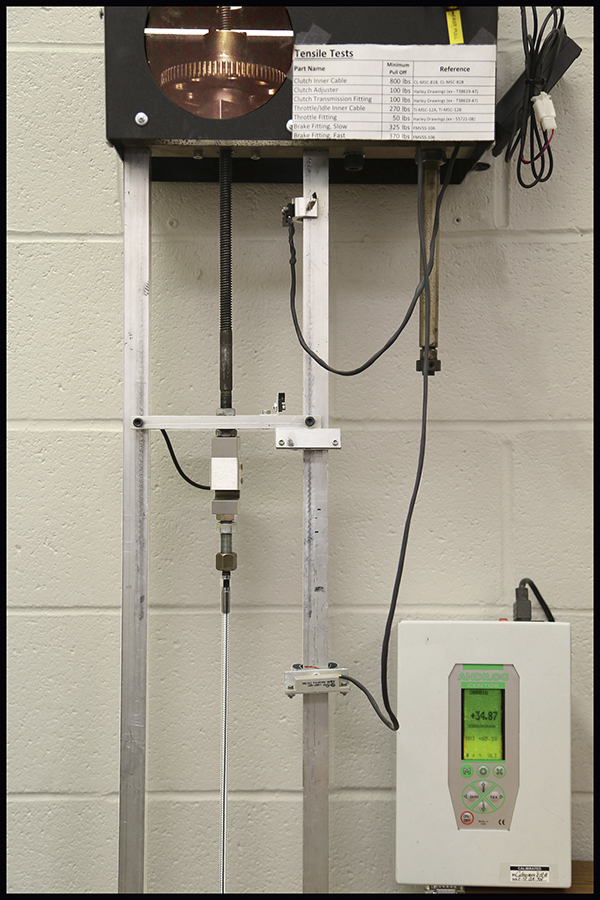
This test consists of subjecting the hose assembly to a gradually increasing tensile load at two different pull rates until failure occurs. This test literally stretches a brake hose assembly until it either pulls off one of the crimped end fittings, or the hose itself fails by tearing or fraying, whichever occurs first.
The hydraulic brake hose assembly must withstand a pull of 325 lbs during a slow pull test and 370 lbs during a fast pull test, without separation from its end fittings. Designing the crimp joint to meet this specification must not compromise the constriction test due to over-crimping the fittings to increase pull-off.


Burst Strength
This is a fun and sometimes loud test. The hydraulic brake hose assembly must withstand water pressure of 4,000 psi for two minutes without rupture. Popular motorcycle brake hoses that have an I.D. of 1/8” must be tested to 7,000 psi. Hoses need not be burst to pass this test, but it may be noted that some 1/8” hoses with high tensile stainless steel or aramid fiber constructions may exceed 25,000 psi before rupturing, and when they do, they do it with a bang!


Whip Test
This is one of the most difficult of all the tests to pass due to the enormous stresses that the hose is subjected to. This is especially true for stainless steel braided lines which experience metal fatigue when being bent continuously on a flexing machine at 800 rpm for a grueling 35 hours. 


The Whip Test is one of the most difficult of all the tests to pass due to the enormous stresses that the hose is subjected to

For an onlooker, the brake hose looks like an airplane prop, a mere blur, and failures usually occur on the hose at or near the stationary end fitting.  The assembly’s hose couplings are mounted on the machine with a very specific amount of slack added to the line, depending on the length of the test sample.  Each end is then locked down with no ability to spin, which would otherwise reduce the stresses on the assembly.
The brake hose assembly is then pressurized with water and monitored via pressure sensors. During the duration of this test, if there is any detection of a drop in pressure from the fittings or hose, it is deemed a failure.  This test ensures that the fittings and hose are designed and manufactured robustly enough to perform on the vehicle over the long term without mechanical failures from vibration, movement or flexing.


Water Absorption Tests
Because brake hose assemblies are constantly being subjected to rain, splashing water, and steam from hot exhaust tubes, this test’s recipe calls for three hose assemblies to be completely immersed in distilled water at 185° F for 70 hours.
Within 30 minutes after removal from the water, they must be subjected to, and pass, the previous three tests again - Tensile, Burst and Whip. Due to the possibility of the hose materials being mildly hydrophilic, water may be absorbed and its physical properties may be altered. This may lead to the assembly experiencing more difficulty passing these three tests.

High Temperature Impulse Test


This is a rather intense test designed to ensure the durability of the brake hose assembly by simultaneously subjecting it to heat and pressure cycling. For approximately 5 hours, an assembly filled with brake fluid is held in a convection oven at 295° F while being pressurized to 1,600 psi.
A pressure cycling machine repeatedly increases the pressure in the hose from zero to 1600 psi within 2 seconds, holds it for 1 minute, and then quickly decreases the pressure back down to zero psi, also within 2 seconds. This full cycle is repeated 150 times! At the completion of this, the line is removed from the oven and allowed to cool for 45 minutes, after which it must pass a 5,000 psi burst test.
When designing a brake hose, the selection of materials must be such that their physical properties are not compromised by high temperatures. For example, if there is a durometer change, which would lead to softening in the presence of heat, the crimp joint may be compromised leading to failure of this test.
 

End Fitting Corrosion Test

Most of us are familiar with this 24 hr salt spray test, which is designed to encourage rust and corrosion to form in a very short period of time. Its purpose is to validate that the materials and plating used on the end fittings will be protective enough to endure in corrosive and harsh environments.
A hose assembly is suspended in the chamber and subjected to a 5% salt solution made with distilled water. The temperature of the chamber is maintained at 95°F - hot and humid, a perfect environment for rust and corrosion.
After 24 hours, the hose end fittings cannot show any base metal corrosion on the surface except where crimping or the application of labeling information has caused displacement of the protective coating.

Brake Fluid Compatibility Test
In order to test the hose’s chemical resistance, the hose is subjected to a temperature of 248° F for 70 hours while filled with SAE RM-66-05 compatibility fluid.  After this, the hose is subjected to a 5,000 psi burst test.

Ozone Resistance

There are two components to this test. One is static and the other dynamic. For the static test, a brake hose assembly is exposed to ozone for 70 hours at 104° F - any cracks seen under 7X magnification are grounds for failure. For the dynamic test, the hose is cycle-flexed on a movable pin for 48 hours, after which it is also examined for cracks.
 

Low Temperature Resistance
A brake hose is chilled to a temperature below
-49° F for 70 hours. It is then bent around a mandrel and inspected for any cracking. It cannot have any cracks as seen without magnification.

Well, there you have it, a general description of “The Torture Tests,” which must be conducted in a very specific sequence. Any brake hose assembly manufacturer who can confidently and proudly state that they are in compliance with all the FMVSS-106 Standards has indeed earned the right to advertise their DOT compliance and compete fiercely in the marketplace.

For Magnum Shielding, DOT compliance drives our quality standards and further reinforces our dedication to, and passion for, total customer satisfaction and safe riding. Our team strives to be the best at what we do and is committed to providing the industry with the highest quality innovative products that dealers have come to know and expect.

MAGNUM SHIELDING
www.magnumshielding.com

Custom Chrome Europe

CCE - LePera ‘Sprocket’ and ‘KickFlip’

Custom Chrome Europe has the latest new seats in stock from the North Holywood, California based workshops of respected seat specialist Le Pera.


Sprocket

Available for selected FXR, Dyna, Sportster and Touring models, a selection of stitch styles is available including ‘Smooth’, ‘Diamond’ and ‘Pleated’.
Two stylish new designs are offered - the ‘KickFlip’ for ’06-’17 Dynas and the Sprocket Solo for ’08 and up Baggers.
Described as a “sinfully ‘Bobbed and Chopped’ design, the ‘Sprocket’ solo creates enough back support for highway riding, with a bobbed back that updates one of our most popular designs from the 1970s,” says Bob Le Pera Jr.


KickFlip

The ‘KickFlip’ for ’06-’17 Dynas is additionally available in ‘Pleated Gripper’ and ‘Basket Weave’ stitch finishes - “this is the seat that every Freestyler would be stoked to own” says Bob.
Like all LePera seats, it has 46 years of handcraftsmanship invested into every detail and features a powder-coated 16-gauge steel base plate, a specially poured high-density “Marathon” molded foam foundation and double-stitched handcrafted cover with bonded polyester thread for durability.

CUSTOM CHROME EUROPE

www.custom-chrome-europe.com
www.lepera.com

Russ Wernimont Designs (RWD)

RWD Fenders and Highway Bar

Available exclusively through Drag Specialties, these fenders by Murietta, California based manufacturer Russ Wernimont Designs (RWD) and made from heavy-gauge steel, with each fender inspected individually to ensure straightness, consistency and a “flawless finish with an absolute minimum of finishing bodywork.” Each fender is pre-drilled for easy bolt-on installation.

Custom dresser fender

Also seen here, the ready-to-paint RWD Flat Back Front Dresser Fender has been laser trimmed to complement the rake of the bike. A direct bolt-on design, no spacers are required. 

Flat back dresser front fender

The RWD 8.5” OEM-style Dyna rear fender is a one-piece, stamped 14-gauge construction, laser-trimmed for a precise fit with minimal paint prep. Welded wire tube for clean wire installation, the fender mount and license plate bracket holes are predrilled and also has taillight cutout for traditional taillight mounting.

8.5” OEM style Dyna Fender

This RWD highway bar/skid plate design with footrests is made in 1 3/4” steel tubing and stamped 14-gauge steel plate with a gloss black powder coat finish.


Highway bar/skid plate with foot rests

Measuring approximately 34” wide x 12” tall, it has high impact plastic “Revolver” end caps that double as footrests. It ships with all necessary mounting hardware (not for use with evaporative emissions canister or Big Bear motor mounts).

DRAG SPECIALTIES
www.dragspecialties.com
www.russwernimont.com

Barnett

Barnett Clutch Shaft Arm for ’14-up Indian Baggers

The latest addition to the line of Indian products from Ventura, California based manufacturer Barnett Clutches & Cables is this new clutch shaft arm to fit 2014 and later Indian Baggers. Barnett says that this new patent pending shaft arm “has been redesigned for better clutch separation, smoother shifting and an easier to find neutral.”  Barnett Clutches & Cables, USA, www.barnettclutches.com

Platinum Air Suspension

‘Bleed Feed’ Tech Air Suspension for 2018 Softails

Fullerton, California based Platinum Air Suspension has announced the launch of a new and improved Bleed Feed Mono Shock Kit for 2018 Softail Models.


With a minimum retracted 10 7/8” and maximum extension of 12 7/8” it has a 3 1/2” diameter and offers 4” of rear lift and shock travel for 2018 Street Bob, Low Rider, Softail Slim, Fat Bob, Deluxe, Sport Glide, Fat Boy, Heritage Classic, and Breakout models.
Founded in 2003, owner Mike Ferris says that “our mission is to bring quality, value and innovative technology to hard-core custom motorcycle riders, using our proprietary Bleed Feed technology to produce the market’s best air suspension riding system.”
Based on the technology that was used in the trucking and aircraft industry, Platinum has adapted and tuned it for the specialty requirement of motorcycle suspension to use pressure for the lift and back pressure for ride height adjustment and rebound control.
“Our system allows the rider to have a lowered look and comfortable ride at any desired ride height. We manufacture and test to rigorous standards and have ‘Bleed Feed’ and ‘Simple’ systems available for H-D/V-twins, metric cruisers and street bike applications.”
For Californian buyers and the EPA regulations, Mike advises removing the canister from the transmission, reinstalling an EPA canister to the Platinum compressor and valve box, then bolt back to the transmission.

PLATINUM AIR SUSPENSION
www.platinumairsuspension.com

Belt Drives Ltd (BDL)

Ball Bearing Lock-Up Clutch Conversion Kit

This ball bearing lock-up clutch from Californian manufacturer Belt Drives Ltd (BDL) is standard equipment with all of BDL’s SS series primary drives.


The conversion kit will convert existing clutches to a ball-bearing lock-up design – applying extra pressure to the clutch plates for positive engagement with no clutch slippage and no increase in lever pull effort.
The complete kits include all the necessary components for a and successful complete retrofit.

DRAG SPECIALTIES

www.dragspecialties.com
www.beltdrives.com

Wednesday, 31 October 2018

Indian Motorcycle

Indian Formally Unveils FTR 1200/S at INTERMOT 

Indian Motorcycle unveiled its new FTR 1200 and FTR 1200 S at INTERMOT, Cologne, Germany, October 1st, stating that “the FTR platform proudly breaks new ground and answers the call of enthusiasts around the world anxiously awaiting its debut.”


Described as being inspired by Indian Motorcycle’s “storied history and success in flat track racing,” they take design and styling cues from the championship-winning FTR750 race bike that has dominated American Flat Track since it was introduced in 2016. It also takes styling inspiration from the FTR1200 Custom, unveiled a year ago as an exploration of what a flat track-inspired street bike could be. 
“Our vision from the beginning was to be more than a traditional American V-twin brand. We continually seek to broaden Indian Motorcycle’s reach to a wider range of riders, and FTR 1200 represents a significant step forward in that strategy,” said Steve Menneto, President, Indian Motorcycle. “Indian Motorcycle was founded on performance and innovation, and we remain grounded by our founder’s mindset of constantly pushing forward. In light of that history, the FTR 1200 is a natural extension for the brand that we couldn’t be more excited about.”
Featuring a new 1203cc V-twin engine with approximately 120 horsepower and 85 ft-lbs of torque that is housed in a trellis frame with a sporty riding position, both models feature an inverted front suspension with radially mounted dual Brembo brakes for exceptional control and stopping power. The fuel tank is strategically located under the seat for a lower center of gravity and more centralized weight distribution.
Similar to the FTR750 race bike, the airbox is positioned directly above the engine to optimize airflow and maximize power. Both models feature a similar rear suspension and swingarm design as the FTR750, newly-developed Dunlop street tires with flat track-inspired tread, a chain final drive, and ProTaper flat tracker aluminum handlebars.
Adding to the design is a host of premium features and ride-enhancing technologies, such as fully adjustable front and rear piggy-back suspension with preload, compression and rebound adjustments; 4.3-inch customizable Ride Command LCD touch screen with Bluetooth for easy mobile device pairing; lean-angle sensitive stability control; ABS; traction control; wheelie mitigation control and three Ride Modes (Sport, Standard, Rain) with unique throttle response and traction control intervention levels.
A flat torque curve is described as ensuring a “predictable power delivery with loads of low-end punch and flexibility.” The engine features a 12.5:1 compression ratio, high flow cylinder heads and dual throttle bodies for optimal airflow and power.  Additionally, the engine makes wide use of magnesium to reduce weight and utilizes a low-inertia crankshaft that allows the engine to rev to its redline.
www.indianmotorcycle.com